
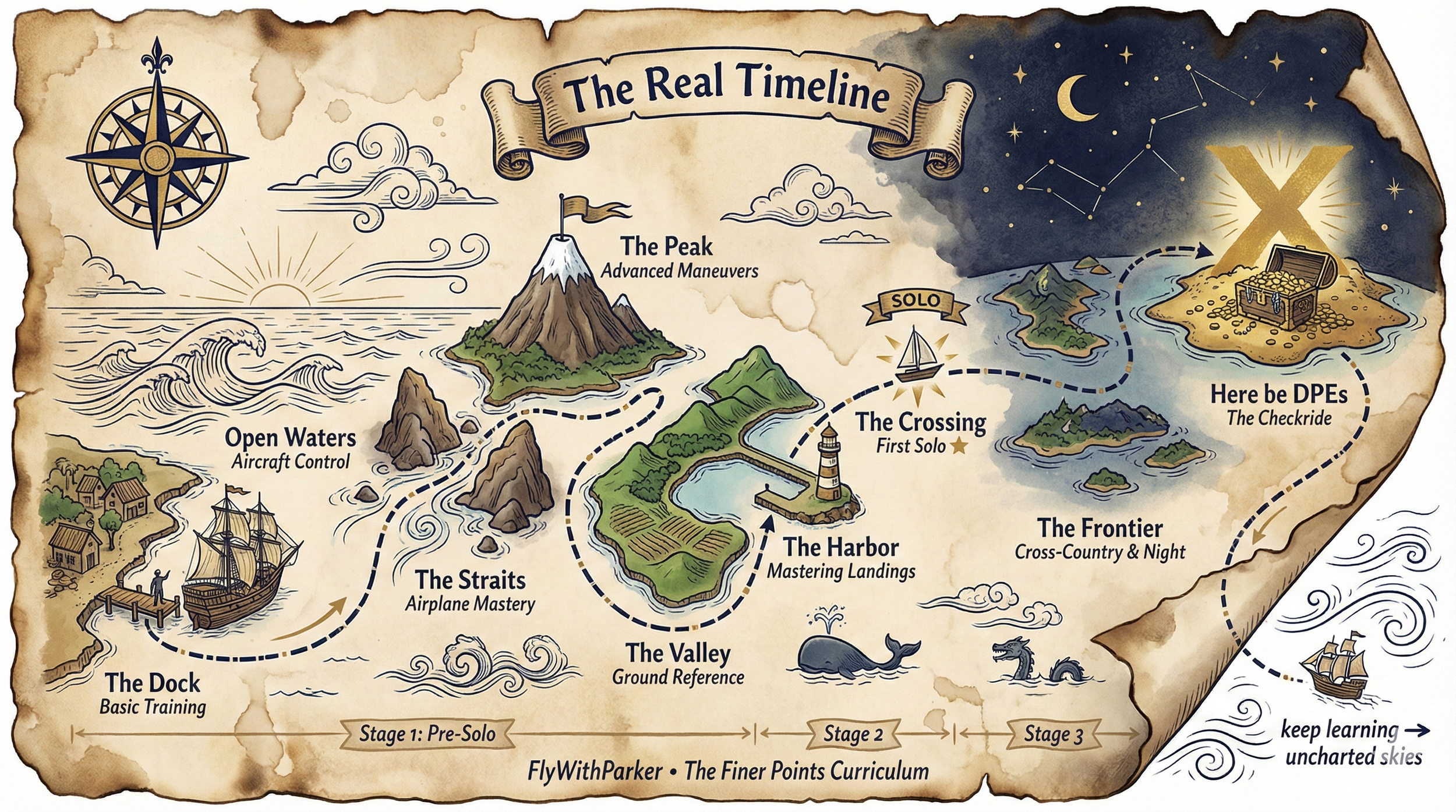
The Real PPL Timeline
By Parker Thomas
A phase-by-phase guide to what you'll learn, when you'll learn it, and why it's taught in this order
You're somewhere in the middle of flight training, and you're wondering: How much longer? What's next? Am I behind?
Those are normal questions. The problem is that most answers you'll find online are just a single number — "the national average is 65 to 75 hours" — which tells you almost nothing useful. It doesn't tell you what those hours are made of, why some skills come before others, or where you are on the map.
At East Bay Flight, we use The Finer Points flight training curriculum — a structured, 10-phase syllabus developed over 20 years by award-winning CFI Jason Miller. It's designed to build skills in a specific order so that each new thing you learn builds on the shoulders of everything before it. Nothing is random. Every lesson has a purpose.
The Big Picture: 3 Stages, 10 Phases, 57 Lessons
Your training is organized into three stages:
Pre-Solo (Phases 1–7, Lessons 1–31): Fly the airplane safely by yourself.
Advanced Training (Phases 8–9, Lessons 28–39): Performance landings, cross-country, night, instruments.
Checkride Prep (Phase 10, Lessons 40–42): Mock checkrides, stage checks, polish to ACS standards.
The FAA minimum is 40 flight hours. The national average, according to DPE Jason Blair's data from hundreds of checkrides, is about 76 hours. With accelerated, high-frequency training — flying 3 to 4 times per week in structured 3-hour blocks — most students finish closer to 55–65 hours. The difference isn't talent; it's consistency and curriculum design.
Stage 1: Pre-Solo
Phase 1 — Basic Training
Intro Flight + Ground Lesson 1
Before you ever touch the controls, you'll learn how we approach flying. You'll learn the Standard Operating Procedures (SOPs) that you'll use on every single flight: how to brief a flight, preflight the airplane, communicate on the radio, and organize a cockpit. Think of this as learning to set up your workstation before doing any actual work.
Phase 2 — Basic Aircraft Control
Flight Lessons 2–6
This is where you learn to actually fly — but not the way you might expect. We don't start with landings. We start with the most fundamental relationship in aviation: power controls altitude, pitch controls airspeed.
Over six lessons: the Four Fundamentals (climbs, descents, turns, straight-and-level), airspeed changes, minimum controllable airspeed, coordination exercises, stall exercises, and your first Demonstration Day to perform these.
Why this order matters: Every one of these skills is a building block for landing. Airspeed control, coordination, energy management, flying at slow speeds — you're learning all the component pieces before you ever see a runway.
A note on instruments: During this phase, your flight instruments are covered or the glass panel is dark. You're learning to fly by looking outside — at the horizon, at the sight pictures, at the Lindbergh Reference out the sides of the front window. This builds a foundation that instruments alone never can.
Phase 3 — Basic Aircraft Maneuvers
Flight Lessons 7–9
This phase is about airplane mastery. Steep Turns at 45° of bank teach you to manage the airplane under higher G-loads, control the overbanking tendency, and maintain altitude with power adjustments. Power-Off Stalls prepare for what might happen if you stall on final approach. You'll set pattern power, fly the right airspeeds, add flaps progressively, and practice the go-around — your escape hatch for a bad approach. By the time you fly a real traffic pattern, the mechanics will already be familiar.
Combined with the slow flight, stall recovery, and coordination skills from Phase 2, you now have all the pieces that landing is made of: energy management, speed control, flying at the edge of the envelope, and pattern procedures. The phase wraps with a Demonstration Day where you perform Slow Flight, Steep Turns, and Power-Off Stalls to ACS (checkride) standards, with your instructor observing silently.
Phase 4 — Advanced Aircraft Maneuvers
Flight Lessons 10–13
Lazy eights, turning stalls, spin prevention, and power-on stalls. This is exploring all of the airplane's capabilities. When you complete this phase, the high-airwork foundation is done and we move toward landing the airplane. Flight instruments become available again — you've earned them.
Phase 5 — Ground Reference Maneuvers
Flight Lessons 14–16
You come down from the practice area: turns around a point, S-turns across a road, rectangular course. These teach you to fly a consistent ground track while the wind pushes you around — which is exactly what a traffic pattern is. You'll also learn pilotage and low-altitude contingency planning.
Phase 6 — Mastering Landings
Flight Lessons 17–22
The key insight: by the time you get here, you already know most of what landing requires. Landing is the practical application of skills you've been building since Lesson 1.
Six lessons break it into components:
Lesson 17 — Aiming Points & Go-Arounds: Stabilized approaches, seeing your touchdown point, and the go-around.
Lesson 18 — The Round Out: The trigger reference point, transitioning from descent to the flare, recovering from a balloon.
Lesson 19 — Touchdown: The flare, contact with the runway, and the rollout.
Lesson 20 — Landing Decision-Making: Forward slips, drift exercises, 180° power-off approaches, simulated engine failure after takeoff.
Lesson 21 — Crosswind Techniques: Crosswind takeoffs and landings.
Lesson 22 — Scenario Flight: Pattern work at a new airport, putting it all together.
If you're stuck on landings right now: Think about when you were 16 and learning to drive. Parking seemed impossibly hard — judging the distances, figuring out where the corners of the car were, getting into a tight spot. It felt like you'd never get it. Now you park without thinking. The same thing will happen with landings. Your brain is building a mental model of where the airplane is in relation to the runway, and that model just needs repetitions to solidify. It's not a knowledge problem; it's a calibration problem, and calibration only comes from practice.
Phase 7 — Emergency Procedures & First Solo
Flight Lessons 23–27 + Stage Check + Solo Flights 1–2
Simulated system failures (engine, alternator, lost comms), engine-out scenarios, cabin fire procedures, emergency descents. Then a mock phase check, a peer-reviewed Pre-Solo Stage Check with another instructor, and finally:
Your first solo. Three trips around the pattern, alone. One of the most memorable days in any pilot's life.
Stage 2: Advanced Training
Phase 8 — Performance Takeoffs & Landings
Flight Lessons 28–30 + Solo Flights 3–4
Short-field techniques, soft-field techniques, and night operations — interspersed with solo flights to maintain and sharpen your maneuvers.
Phase 9 — Cross-Country Operations
Ground Lesson 2, Flight Lessons 31–39, Solo Flights 5–10
The longest phase. You'll start with dead reckoning and pilotage on paper charts (no GPS), progress through basic instrument maneuvers and radio navigation, fly night cross-countries, then integrate modern EFB tools. The phase culminates with three solo cross-countries, including the "long solo" (150 NM, three stops) that fulfills the Part 61 requirement.
The technology transition: You spent the first half of training with instruments covered, using paper charts, doing math by hand. Now that you understand what the technology actually does, you use it — and you use it better than someone who never learned the fundamentals.
Stage 3: Checkride Preparation
Flight Lessons 40–42 + Ground Lesson 3 + Solo Flight 11
Mock checkride. Solo practice to ACS standards. Ground review of written test and oral prep. Second mock checkride aimed at being harder than the real thing. Final Stage Check — a peer-reviewed evaluation that should be the hardest day of your training.
"There is a reason that baseball players swing with two bats before they go up to the plate; it makes the real thing easier."
The goal: You walk out of your checkride saying, "That was easy."
The national average is 65–76 hours. With consistent, focused training, you can be on the efficient end. But the hours aren't the point. The point is that when you pass that checkride, you're not just legal — you're genuinely competent and safe. That's what this curriculum is designed to produce.
Accelerated Instruction FAQ
Accelerated flight instruction is a focused and intensive approach to learning to fly (and other ratings), aimed at helping you achieve your certification efficiently while maximizing the quality of your training. It’s not about rushing—it’s about dedicating a concentrated block of time to immerse yourself in flying, away from the usual distractions of life. Here are answers to the most common questions I get.
What is accelerated instruction?
Accelerated flight instruction is a concentrated training program designed to help you achieve a rating in a much shorter time frame. It involves intense daily lessons to create an immersive experience.
Who is accelerated instruction for?
Accelerated instruction is best for people with significant commitments outside of aviation who are interested in making serious progress quickly.
How is this different from regular flight instruction?
The key differences are:
Time Commitment: You’ll fly and study daily for a set period.
Focus: The program eliminates unnecessary downtime, helping you achieve your goal efficiently.
Intensity: Lessons are longer and more frequent, requiring focus and preparation.
What certifications or ratings can I achieve with accelerated instruction?
All of them. Accelerated instruction is commonly offered for:
Private Pilot Certificate
Instrument Rating
Commercial Pilot Certificate
CFI
What preparation is required before starting?
To maximize our time together, you’ll need to:
1. Pass the written exam for your rating with a 90% of above. The 90% is arbitrary, but demonstrates that you have a solid understanding of the knowledge required for your certification.
2. Master the ACS (Airman Certification Standards): Familiarize yourself with the ACS, so you know exactly what’s expected on the practical test.
But the real switch in getting ready for accelerated instruction is more of a mental model: you need to think of yourself as the instructor responsible for getting you ready for the tests. That means you have to understand the requirements in detail, help to create the path to those requirements and constantly evaluate where you are relative to them. In essence, you are hiring a guide to help you get ready for the test. You're not hiring an instructor to spoon-feed you.
How long does accelerated instruction take?
This depends on you, your ability to learn and your preparation.
- Instrument Rating: Typically roughly 10 days if prerequisites are met.
- Private Pilot: 3–4 weeks with intense daily flying and study.
Is accelerated instruction harder than traditional instruction?
Not necessarily—it’s just different. While the pace is faster, you’re also more focused, which often makes learning easier and the skills don’t fade between lessons.
What are the benefits of accelerated instruction?
Consistency: You retain knowledge and skills better with daily practice.
Focus: You have fewer distractions from work, family, or other commitments.
Instructor Access: One-on-one attention from your instructor all day for the duration of the training.
What are the potential challenges?
Intensity: The program requires sustained focus and energy, which can be mentally and physically exhausting. These are long days - 10 or 11 hour days with the entire day spent flying or talking about flying.
Preparation: Without proper preparation (e.g., written exam completed), you may struggle to keep up.
Cost: While the per-day cost may be higher, the total cost is often comparable to traditional training due to the reduced overall timeline.
How do I know if accelerated instruction is right for me?
Consider this approach if:
You can dedicate a block of time exclusively to training.
You prefer an immersive environment.
You’re prepared to focus on flying without distractions.
You’ve already passed the written exam and have a thorough understanding of the material.
What’s expected of me during training?
Have FUN. Seriously. Flying is incredibly fun and every minute up there should be relished. We are going to take the flying very seriously, but not ourselves.
Commitment: Show up prepared, rested, and ready to learn.
Openness to Feedback: Be willing to make mistakes and learn from them quickly.
How does accelerated instruction affect the cost?
While the upfront cost may seem higher due to the condensed timeline, you often save money overall by avoiding prolonged schedules, repeated lessons, and skill atrophy over time.
What happens if I don’t finish in the accelerated timeframe?
Sometimes unforeseen factors (weather, skill readiness) can extend the program. Most schools or instructors will work with you to complete the training as quickly as possible.
Is there something I missed? Just send me a note at the number or email below and I'll add it to the list.

What is Accelerated Instruction?
Dead engine training during an intensive four days of multi-engine training.
Over the past seven months, I’ve earned my instrument (10 days), commercial (4 days), multi-engine (3 days), and CFI ratings (4 days) using an approach called “accelerated instruction”. This has been one of the hardest things I’ve done as an adult but the approach was absolutely worth it.
Accelerated flight instruction was a game-changer for me. I spent close to two months flying once or twice a week moving at a snail’s pace towards instrument. It was incredibly frustrating trying to schedule my instructor, schedule the airplane and balance my own family obligations while trying to be ready for every lesson. Accelerated training is simply the best approach to achieving your aviation goals if you have a life outside of flying.

Dead engine training in a Cessna 310 during an intensive 4 day multi-engine course.
What is accelerated instruction?
Accelerated flight instruction is a focused and intensive approach to learning to fly (and other ratings), aimed at helping you achieve your certification efficiently while maximizing the quality of your training. In most cases an instructor will come to you, though there are several schools you can attend. You’ll spend upwards of 10 hours a day flying and talking about flying. It’s not about rushing—it’s about dedicating a concentrated block of time to immerse yourself in flying, away from the usual distractions of life. For me, what worked best was starting around 7 am with a lesson, a flight in the morning, a lesson over lunch, a flight in the afternoon and another lesson after, breaking around dinner time. Sometimes we would do another flight in the afternoon.
How long does it take?
It depends completely on you. What makes accelerated instruction so attractive to me is that I can go as fast as I can. I'm seldom the fastest person in any classroom, but I'm never the slowest. So I find virtually all classrooms to be BORING. Having a dedicated instruction instructor meant I could move at my own pace. Which ended up being pretty fast. My instrument reading took 10 days, commercial took four days, multi took three days and CFI took four days. That does not count considerable preparation before.
What do you have to do to prepare for accelerated instruction?
The two absolute requirements are that you 1) pass the written exam for the rating before you start (and get higher than a 90%). The 90% is arbitrary, but it's a signal that you understand most of the material and 2) Be familiar with the ACS requirements for the rating as if you were the instructor.
But the real switch in getting ready for accelerated instruction is more of a mental model: you need to think of yourself as the instructor responsible for getting you ready for the tests. That means you have to understand the requirements in detail, help to create the path to those requirements and constantly evaluate where you are relative to them. In essence, you are hiring a guide to help you get ready for the test. You're not hiring an instructor to spoon-feed you.
Accelerated flight instruction isn’t just a way to check boxes—it’s a way to immerse yourself in aviation, achieve your goals efficiently, and minimize the disruptions to the rest of your life. For people like me, with a family, a job, and limited time, it’s the ideal path.